Methods of investigating
This project investigates the visual language of London’s railings in the Westminster area, mostly focusing on Buckingham Palace and the parks around it (Green Park and St. James’s Park). I used a collective and photographic method of gathering visual material throughout the process. This method allowed me to document various angles and shapes of metal grids to experiment with, as well as to research the historical and cultural meaning of fences in London’s urban landscape.
Written response:
In this written response, I explore two readings — Robert Venturi, Denise Scott Brown, and Steven Izenour’s Learning from Las Vegas (1972), and Georges Perec, “The Street”, “The Neighbourhood” and “The Town” from Species of Spaces and Other Places (1974) — and discuss their relation to my project.
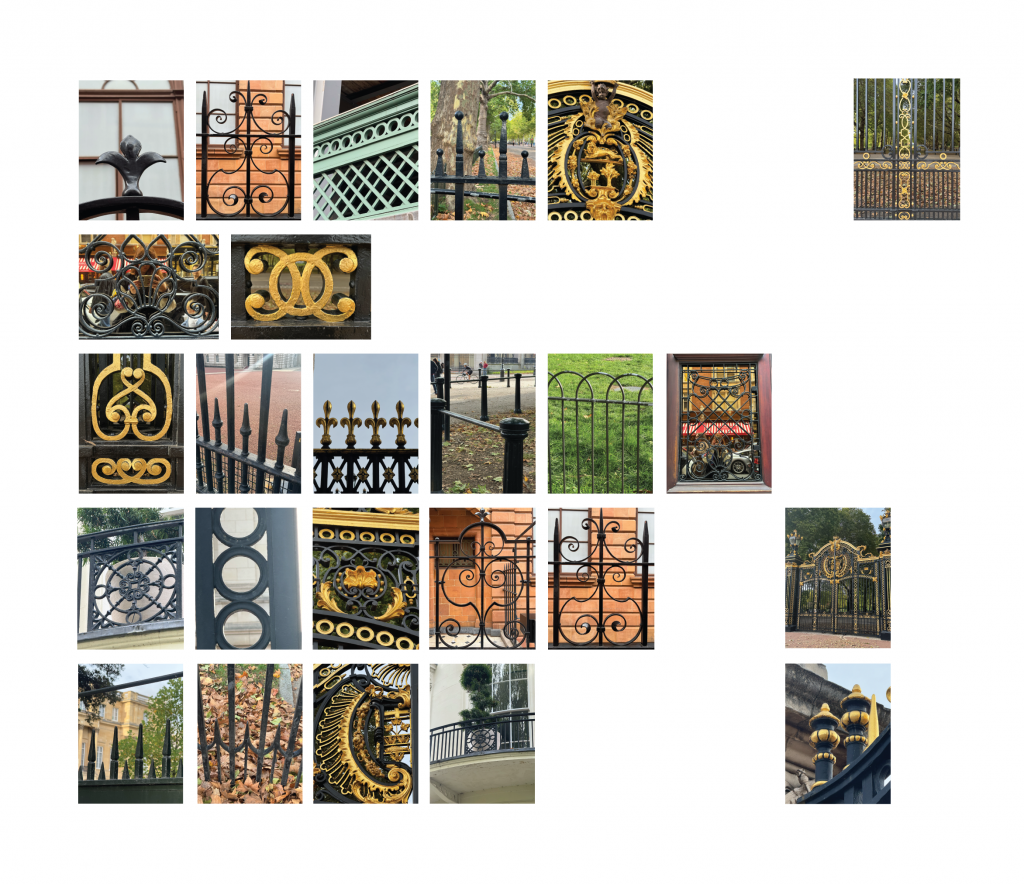
During my investigation, I asked whether the shapes, positions and symbols of fence grids could serve as tools for storytelling about London’s history or even its contemporary life. What insights into the city’s visual language can a designer gain by observing fences around Westminster? In the book Learning from Las Vegas (1972), the authors look at Las Vegas from a similar perspective. They conclude that in modern architecture, ordinary elements are powerful tools to build true connection between communication and society. It was interesting to follow how authors use semiotics to reflect how urban buildings “speak” through visual symbols, texts and signs. Likewise, I see London’s railings as a coded system of communication, expressing historical identity through ornament and structure.
“We look backward at history and tradition to go forward; we can also look downward to go upward.”
– Venturi, Robert, et al. Learning from Las Vegas.
Revised Edition. 1972. p. 3
After collecting and analysing various metal grids, I started to notice variations in shapes, textures and scratches. The metal grids around massive historical architecture often remain invisible, yet by observing them closely, their beauty and character start to appear. In the book Species of Spaces and Other Places, 1974, Georges Perec refers to this act of attention as the observation of “Decorated Shed’“. I was inspired by his approach of bringing attention to the ordinary environment or the objects we often overlook. I found “The Street” chapter the most relatable to my process making. It helped me to train my eye and build questions: how we perceive and describe the spaces around us, and whether they can become a source of creative inspiration. After this initial stage of collection, I decided to focus on translating the fences grid textures into patterns, typographic forms and even textile designs.Through experimenting I tend to find more intriguing shapes and elements I haven’t noticed before.
Note down what you can see. Anything worthy of note going on. Do you know how to see what’s worthy of note? Is there anything that strikes you? Nothing strikes you. You don’t know how to see.”
– Perec Georges Species of Spaces and Other Pieces.
2010. p.50
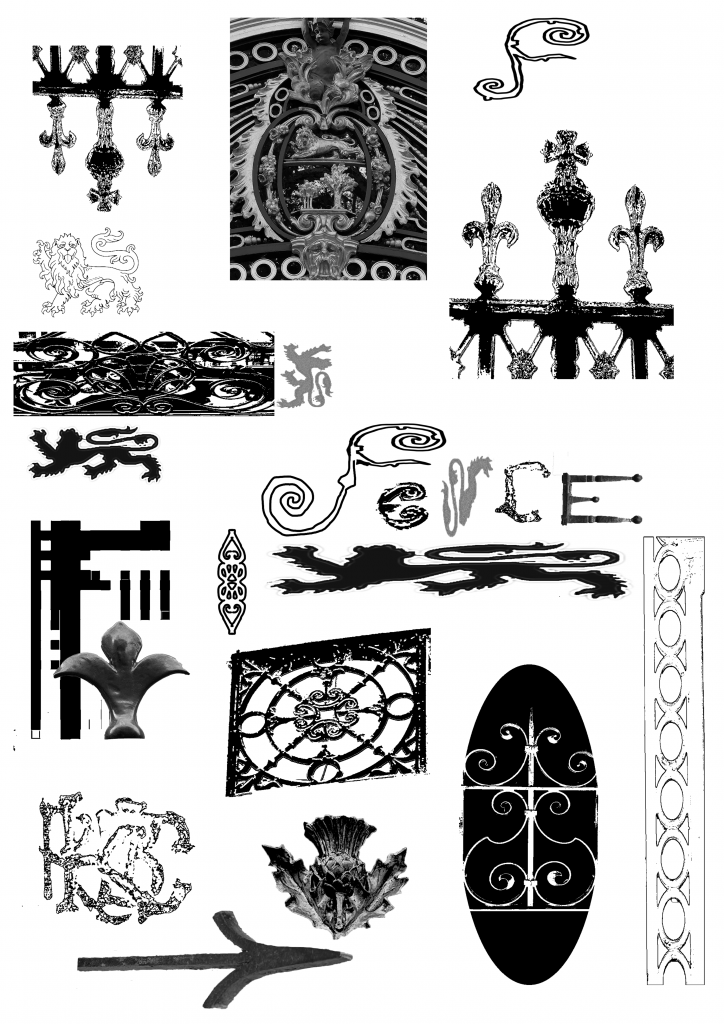
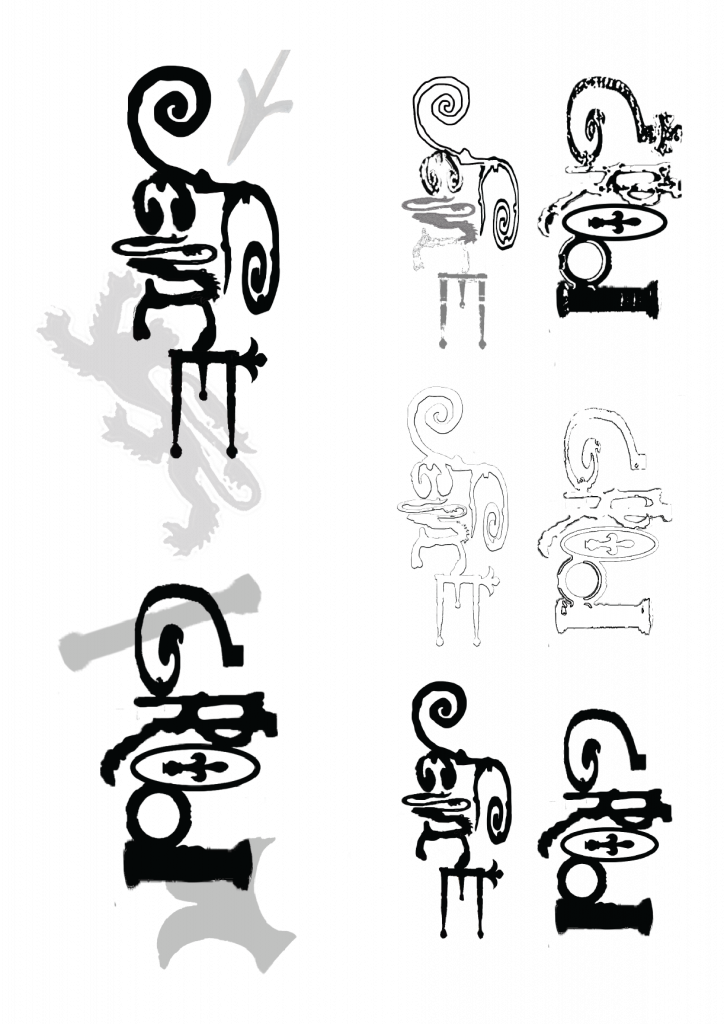
In conclusion, I found Robert Venturi, Denise Scott Brown, Steven Izenour and Georges Perec’s ideas to have a deep conceptual affinity, although they discuss different disciplines. Each author depicts “ordinary things” as significant and worthy of analysis. Both readings encouraged me to reconsider how urban details, such as metal grids, can speak visually and conceptually. Together, they helped me structure my theme and shaped my process of transforming physical barriers into graphic and textile narratives of protection and ornament.
Reference list:
1. Venturi, R., Brown, D. and Lzenour, S. (1972). LEARNING FROM LAS VEGAS revised edition. [online] Available at: https://monoskop.org/images/archive/c/cd/20170506121429%21Venturi_Brown_Izenour_Learning_from_Las_Vegas_rev_ed_missing_pp_164-192.pdf.
2. Perec, G. and Sturrock, J. (n.d.). PENGUIN TWENTIETH -CENTUR Y CLASSICS Species of Spaces and Other Pieces EDITED WITH AN INTRODUCTION AND TRANSLATED. [online] Available at: https://doarch152spring2015.wordpress.com/wp-content/uploads/2015/01/perec-species-of-spaces.pdf.